Jupiter’s Great Red Spot
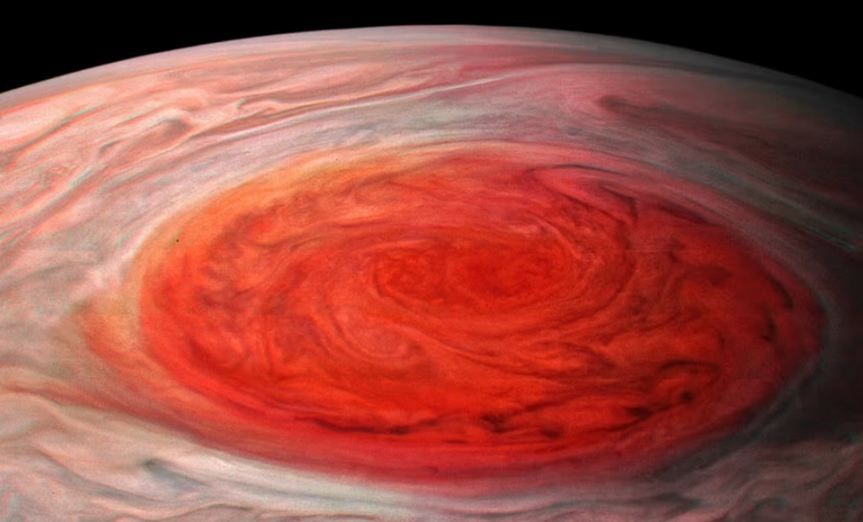
The Great Red Spot on Jupiter has long fascinated scientists and astronomers alike. This massive storm has been swirling on the largest planet in our solar system for centuries. However, recent research has shed new light on how and when it formed, revealing intriguing details about its origins and longevity.
Historical Size and Shape Changes
Back in 1879, Jupiter’s Great Red Spot was a staggering 24,233 miles across. Over time, it has gradually shrunk to its current diameter of 8,700 miles. Interestingly, it has also evolved from an oval shape to a more rounded form. These changes have been closely monitored, providing valuable insights into the dynamics of this colossal storm.
The Origins of the Great Red Spot on Jupiter
Although the Great Red Spot has been known for a long time, the exact details of its formation were unclear until recently. Scientists now believe that the storm responsible for the Great Red Spot has been raging for over 300 years. This gigantic storm is even larger than Earth. However, new findings suggest that it might not be as ancient as previously thought.
Cassini’s Observations and Modern Discoveries
Historically, it was believed that Giovanni Cassini was the first to observe the Great Red Spot in the 1600s, referring to it as the “Permanent Spot.” Yet, it wasn’t until the 1830s that the red area was identified and named the Great Red Spot (GRS). Some researchers speculate that Cassini may have observed an earlier, larger storm on Jupiter’s surface.
Recent Research Findings about Jupiter
A study published in the journal Geophysical Research Letters explored the longevity of the Great Red Spot. Researchers examined historical observations of the spot, dating back to the 1600s. Study co-author Agustin Sanchez-Lavega, a professor at the University of the Basque Country, stated, “From the measurements of sizes and movements, we deduced that it is highly unlikely that the current GRS was the PS observed by G. D. Cassini. The PS probably disappeared sometime between the mid-18th and 19th centuries, in which case, we can say that the longevity of the Red Spot now exceeds 190 years at least.”
The Role of Juno Mission
The Juno mission, currently orbiting Jupiter, has provided crucial data about the Great Red Spot. Instruments on board Juno have revealed that the GRS is relatively shallow and thin compared to its vast horizontal dimensions. Vertically, it measures about 500 kilometers long, offering a clearer picture of its structure.
Simulating Atmospheric Conditions of Jupiter
Researchers have simulated the wind vortices across Jupiter’s atmosphere to understand the origins of the Great Red Spot better. Their findings suggest that the GRS did not originate from the eruption of a massive superstorm, a phenomenon sometimes observed on Saturn. Instead, specific wind conditions could have led to the formation of an extended storm cell, trapping winds and creating a proto-GRS. This process may explain the gradual shrinkage observed over time.
Conclusion
The mystery behind Jupiter’s Great Red Spot continues to captivate scientists and enthusiasts. Recent studies have provided deeper insights into its origins, evolution, and current state. As research progresses, we may uncover even more fascinating details about this iconic feature of our solar system’s largest planet. Stay tuned to ‘Not Viral’ for the latest updates and discoveries about Jupiter and other astronomical phenomena.
Feel free to leave a comment below and share your thoughts on Jupiter’s Great Red Spot and its intriguing history.