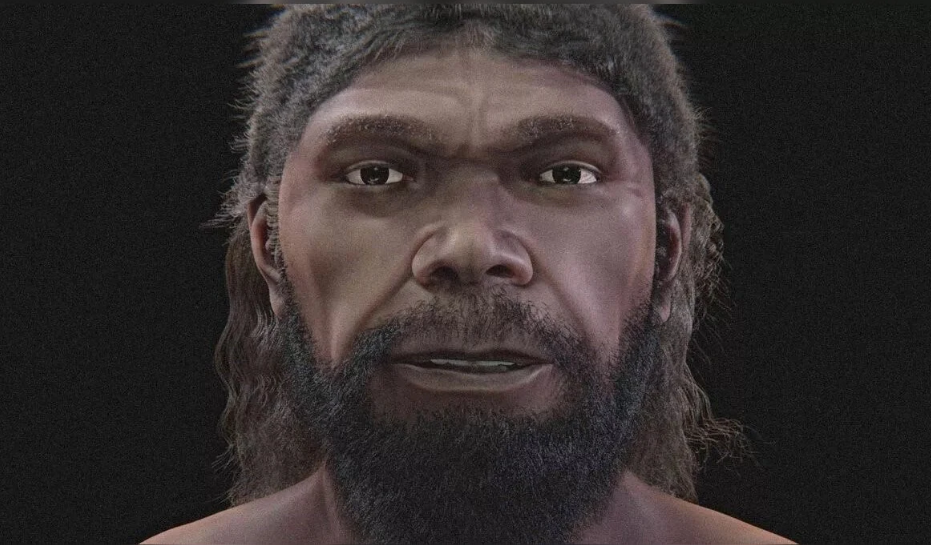
Reconstructing the Face of Our Earliest Ancestor
For the first time, with the help of Jebel Irhoud bones, scientists have reconstructed the face of an early human ancestor, providing a fascinating glimpse into an individual who lived approximately 300,000 years ago. This groundbreaking discovery offers new insights into human evolution and challenges previous assumptions about our history.
Discovery of the Jebel Irhoud Bones
The Jebel Irhoud bones, discovered in Morocco, have revolutionized our understanding of human ancestry. These remains have pushed back the estimated emergence of Homo sapiens by 100,000 years, indicating that our ancestors existed much earlier than previously believed. Furthermore, the findings suggest that early humans migrated beyond East Africa, the traditional “cradle of mankind,” far earlier than anticipated.
The Process of Facial Reconstruction with the help of Jebel Irhoud bones
The facial reconstruction was achieved by Brazilian graphics expert Cicero Moraes, who meticulously analyzed the skull’s shape to create a realistic depiction. Moraes described the reconstructed face as “strong and serene.” By using 3D scanning technology and data from the Max Planck Institute, he was able to perform a detailed facial approximation.
Steps Involved in the Reconstruction
Initially, Moraes scanned the Jebel Irhoud skull in 3D. He then proceeded with the facial approximation, which involved several approaches, including anatomical deformation. This process used the tomography of a modern human, adapting it so that the donor’s skull became the Jebel Irhoud skull, resulting in a compatible and realistic face.
Significance of the Reconstruction
This facial reconstruction is not just a scientific achievement; it is a window into our distant past. The ability to visualize an ancestor from 300,000 years ago provides a tangible connection to our evolutionary history. It also emphasizes the importance of continued exploration and research in understanding human origins.
Implications for Human Evolution
The reconstructed face of this early human ancestor challenges existing timelines and theories about the emergence and migration of Homo sapiens. It underscores the complexity of human evolution and the need to re-evaluate our historical narratives. The Jebel Irhoud bones have provided critical evidence that our ancestors were more widespread and diverse than previously thought.
Jebel Irhoud bones – A New Perspective on Human Ancestry
The reconstruction of the face from the Jebel Irhoud bones is a milestone in the study of human evolution. It offers a new perspective on our ancestors and highlights the advancements in scientific techniques that make such discoveries possible. As we continue to unearth and analyze ancient remains, our understanding of human history will undoubtedly become richer and more detailed.
Stay tuned to ‘Not Viral’ for more updates on groundbreaking discoveries and insights into our past.