

Indian stock markets recently saw a mixed performance, with major indices like the Nifty 50 reaching new all-time highs, while broader markets such as mid-caps and small-caps faced a correction. This has led to common concerns among investors: Does hitting a market high automatically signal a decline? How should investors navigate these peaks?
Does a Market High Automatically Mean a Fall?
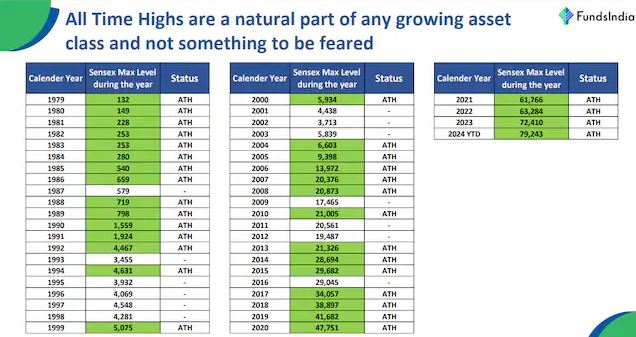
The short answer is no. Historical data shows that reaching new market highs does not necessarily predict an imminent decline. In fact, markets often continue to rise even after reaching new peaks.
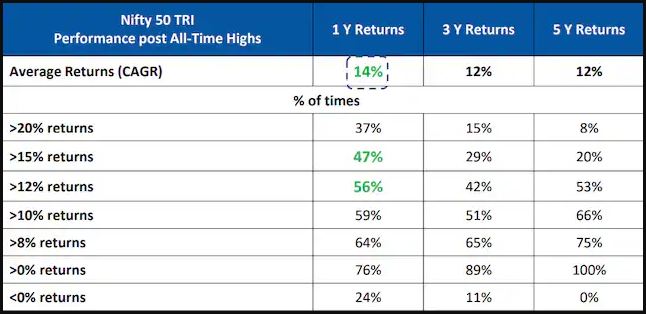
Historical Insights: FundsIndia’s research reveals that 57% of the time, one-year returns following an all-time high are positive. The average one-year return for investments in the Nifty 50 TRI during an all-time high has been approximately 14%. This suggests that market highs can be part of a broader upward trend rather than an immediate precursor to a downturn.
According to Jiral K Mehta, Senior Analyst at FundsIndia, all-time highs are a natural and expected part of long-term equity investing. Markets need to hit new highs to sustain growth. For instance, if Indian equities are expected to grow at around 12% per annum, the index will likely double in about six years, quadruple in twelve, and increase tenfold in twenty years. This inevitable growth trajectory involves surpassing several all-time highs.
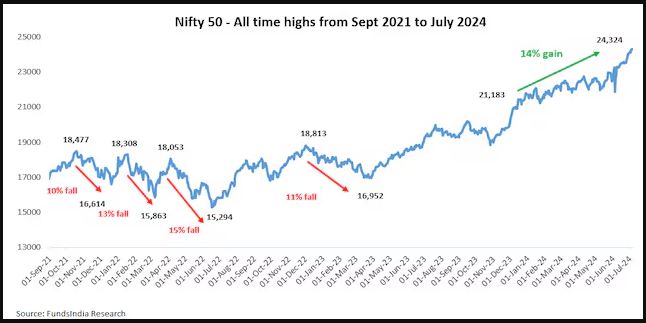
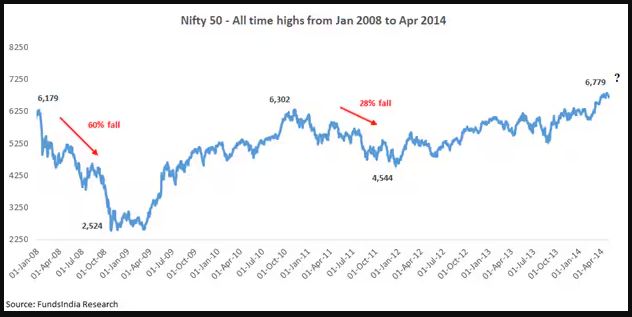
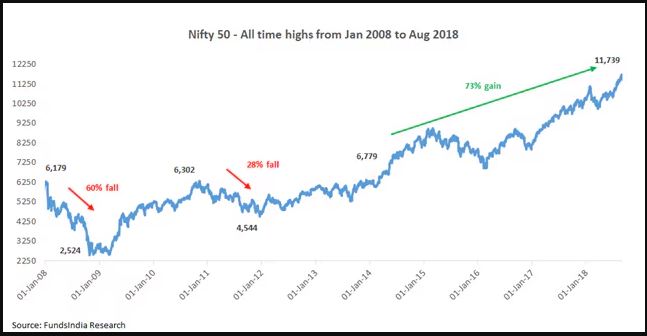
Historical Patterns: Historical patterns indicate that after periods of stagnation and repeated highs, markets often break out and continue to grow. For example, between 2008 and 2011, the Nifty 50 repeatedly hit the 6,000 levels but faced significant declines of up to 60% and 28%. However, contrary to previous patterns, the market surged by 73% in 2014 following a new all-time high.
FundsIndia’s analysis of the Nifty 50 TRI over the past 24 years shows that 100% of the five-year returns were positive following an all-time high. On average, one-year returns were about 14%, with 47% of these highs followed by returns exceeding 15% and 57% seeing returns above 12%.
What Should Investors Do?
Given the data, here’s how investors should approach the current market conditions:
- Maintain Your Asset Allocation:
- Stick with your long-term asset allocation strategy. For instance, if your plan is to have 70% in equity and 30% in debt, continue with this split. Avoid making significant adjustments based solely on recent market highs.
- Rebalance if Necessary:
- If your equity exposure deviates by more than 5% from your original allocation, rebalance by moving funds between equity and debt to restore your intended asset allocation.
- Continue Existing SIPs:
- If you have ongoing Systematic Investment Plans (SIPs), continue with them. SIPs are designed to take advantage of market fluctuations and build wealth over the long term.
- Invest New Money Strategically:
- Debt Allocation: Invest new money in debt instruments immediately.
- Equity Allocation: Invest 30% of new funds now and stagger the remaining 70% through a six-month weekly Systematic Transfer Plan (STP). This approach allows you to take advantage of market dips while remaining invested over time.
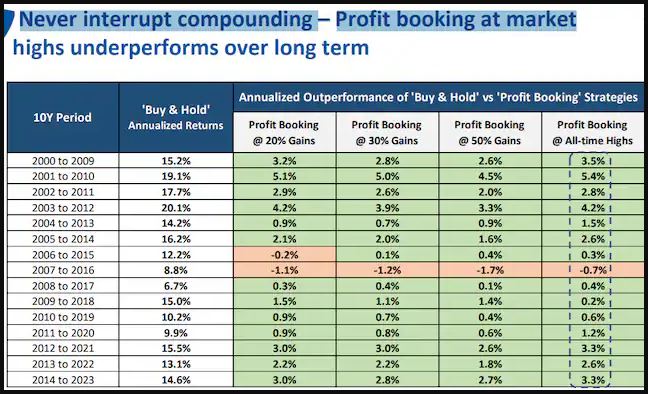
Reaching new market highs is a normal part of market cycles and does not necessarily indicate an impending fall. Historical data suggests that markets often continue to grow after hitting all-time highs. Investors should focus on their long-term investment strategies, maintain their asset allocation, and use systematic investment approaches to navigate market fluctuations effectively.
By adhering to a disciplined investment strategy and avoiding knee-jerk reactions to market highs, investors can better position themselves to benefit from long-term growth.


