
The Union Budget 2024 has brought significant changes for taxpayers under the New Tax Regime. Finance Minister Nirmala Sitharaman announced these changes, providing more relief for taxpayers. With an increased standard deduction and revised tax slabs, taxpayers can save up to Rs 17,500. This article will explore these changes and their benefits for taxpayers.
Introduction to the New Tax Regime Changes
In the Union Budget 2024, Finance Minister Nirmala Sitharaman introduced several changes to the New Tax Regime. These changes aim to provide relief to taxpayers and make the tax system simpler. The key changes include:
- Increased standard deduction limit from Rs 50,000 to Rs 75,000.
- Revised tax slabs for the New Tax Regime.
- Potential savings of up to Rs 17,500 for taxpayers.
Let’s dive into the details of these changes and understand their impact.
Increased Standard Deduction
The standard deduction has increased from Rs 50,000 to Rs 75,000. This change means that salaried employees can now save more on their taxable income. This increase is a significant step toward providing relief to taxpayers.
Revised Tax Slabs
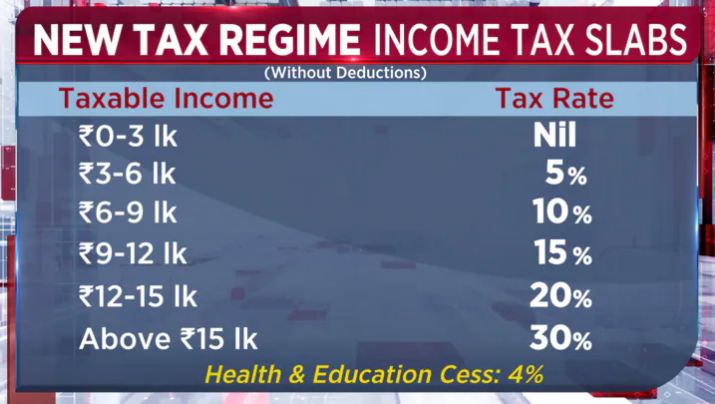
The new tax slabs under the New Tax Regime are as follows:
| Income Range (Rs) | New Tax Rate (%) | Old Income Range (Rs) | Old Tax Rate (%) |
|---|---|---|---|
| 0 – 3 lakh | Nil | 0 – 3 lakh | Nil |
| 3 – 7 lakh | 5 | 3 – 6 lakh | 5 |
| 7 – 10 lakh | 10 | 6 – 9 lakh | 10 |
| 10 – 12 lakh | 15 | 9 – 12 lakh | 15 |
| 12 – 15 lakh | 20 | 12 – 15 lakh | 20 |
| Above 15 lakh | 30 | Above 15 lakh | 30 |
These revised slabs aim to provide more benefits to taxpayers, especially those in the middle-income group.
Tax Savings for High-Income Earners
Taxpayers with a taxable income of Rs 15 lakh or higher will benefit from the increased standard deduction limit. This enhancement results in a savings of Rs 7,500 for these taxpayers. Additionally, the rationalization of tax rates leads to an additional savings of Rs 10,000. Consequently, they can enjoy total savings of Rs 17,500 due to these combined benefits.
Breakdown of Potential Savings
Let’s look at a detailed breakdown of the potential savings:
- Base Income Tax Savings: Rs 17,500 (excluding cess and surcharge).
- Tax Exemption on Income up to Rs 7.75 Lakhs: As per analysis by Ernst & Young (EY), individuals will be exempt from paying taxes on income up to Rs 7.75 lakhs.
- Additional Savings for Income up to Rs 10 Lakhs: Potential savings of Rs 10,000 before cess is applied. If the cess is factored in, the total benefit increases.
Benefits for Different Income Groups
All taxpayers earning over Rs 12 lakh will benefit from a tax savings of Rs 10,000 due to the rate rationalization. However, the savings resulting from the standard deduction increase will vary based on the respective income groups. Taxpayers in higher tax brackets will experience lower savings compared to those in lower brackets. The standard deduction savings are calculated in accordance with the applicable income tax rate, varying for different income brackets.
Expert Opinions
CA Pitam Goel, Co-Founder of Tattvam Group, stated, “The benefits available for the new tax regime for individuals have been further rationalized to encourage individuals to opt for the new tax regime. The slab rates have been further rationalized to provide tax benefits of up to Rs 17,500. The government is making the new tax regime increasingly lucrative for individuals in the interest of carving a path towards a simpler tax mechanism.”
Surabhi Marwah, Tax Partner at EY India, added, “The changes in the new tax regime will benefit taxpayers. For instance, under Scenario 3, where the gross salary is Rs 20,00,000, the total tax payable under the current new tax regime amounts to Rs 2,96,400, whereas under the proposed new tax regime, the tax payable is reduced to Rs 2,78,200.”
Additional Benefits
The New Tax Regime also offers other benefits:
- Increased Standard Deduction for Salary Income: From Rs 50,000 to Rs 75,000.
- Increase in Deduction for Employer and Employee Contribution to National Pension Scheme.
- Increased Deduction for Income from Family Pension: Available only to individuals opting for the New Tax Regime.
Finance Minister Sitharaman also increased the tax deduction on family pensions for pensioners. While presenting the Union Budget 2024 in the Lok Sabha, the FM noted that the tax deduction will rise from the current Rs 15,000 to Rs 25,000.
Old Tax Regime Remains Unchanged
The Finance Minister has kept the Old Tax Regime unchanged for now. Responding to a question on the Old Tax Regime, Nirmala Sitharaman said, “We want a simpler tax regime. The New Tax Regime was introduced with the same intent. At present, the Old Regime is ongoing. However, I can’t comment on the sunset of the Old Tax Regime.”
In the Old Tax Regime, the basic exemption limit was set at Rs 2.5 lakh for individuals below 60 years of age. For senior citizens aged above 60 but below 80, the basic tax exemption limit was Rs 3 lakh. For super senior citizens aged 80 years and above, the basic tax exemption limit was Rs 5 lakh. The Old Regime provides several deductions and exemptions for individuals, including house rent and leave travel allowances, as well as deductions under Sections 80C, 80D, 80CCD(1b), and 80CCD(2). However, these exemptions and deductions are not available in the New Tax Regime.
Conclusion
The Union Budget 2024 has brought significant changes to the New Tax Regime, providing more relief and benefits to taxpayers. With increased standard deductions, revised tax slabs, and potential savings of up to Rs 17,500, the new tax regime aims to make the tax system simpler and more beneficial for taxpayers. Understanding these changes and their impact can help taxpayers make informed decisions about their tax planning and savings.


